
Managing large volumes of documents can become time-consuming and inefficient when files are stored only in physical form. Businesses today are increasingly adopting Document Scanning and Indexing to improve how they store, organise, and access information.
Instead of searching through cabinets and folders, digital systems allow instant retrieval of files with just a few clicks. This approach not only saves time but also helps create a more structured and reliable way to manage important records in everyday operations.
What Is Document Scanning and Indexing?
Document scanning involves converting physical documents into digital formats, while indexing is the process of organising those digital files so they can be easily searched and retrieved. Together, these processes form the foundation of efficient document management.
Indexing can include assigning names, categories, dates, or keywords to each file, making it simple to locate specific documents when needed. This combination transforms unorganised paper records into a structured and accessible digital system.
Why Businesses Need Organised Document Systems
Without proper organisation, even digital files can become difficult to manage. Businesses often deal with contracts, invoices, reports, and other important documents that need to be accessed quickly. A well-structured system ensures that employees can find what they need without wasting time. By using Document Scanning Solutions, companies can create a centralised database where all files are stored securely and organised logically. This improves workflow and reduces delays caused by misplaced or hard-to-find documents.
Key Benefits of Document Scanning and Indexing
Implementing scanning and indexing offers several practical advantages:
- Faster document retrieval through keyword-based search
- Reduced dependency on physical storage space
- Improved accuracy in file organisation
- Easier sharing of documents across teams
- Better protection against loss or damage
These benefits make it easier for businesses to handle large volumes of data efficiently.
How Indexing Improves File Accessibility
Indexing is what makes digital documents truly useful. Without indexing, files are simply stored images that can still be difficult to locate. By adding searchable data to each document, indexing allows users to find files instantly based on specific criteria. For example, you can search by client name, date, or document type. This level of organisation saves time and makes daily operations smoother.
Different Types of Indexing Methods
There are several ways to index documents depending on business needs:
- Basic Indexing – Assigning simple file names or numbers
- Field-Based Indexing – Using multiple fields like date, category, or department
- Full-Text Indexing – Allowing search within the content of the document
- Custom Indexing – Tailored systems based on specific business requirements
Choosing the right method depends on how frequently documents are accessed and how detailed the search needs to be.
Industries That Benefit from Scanning and Indexing
Many industries rely on organised document systems to operate efficiently. Healthcare providers use indexing to manage patient records, while legal firms depend on it to organise case files. Financial institutions use it to handle large volumes of transactions and records.
Even small businesses can benefit by improving their internal organisation and reducing the time spent searching for documents. This makes scanning and indexing valuable across different sectors.
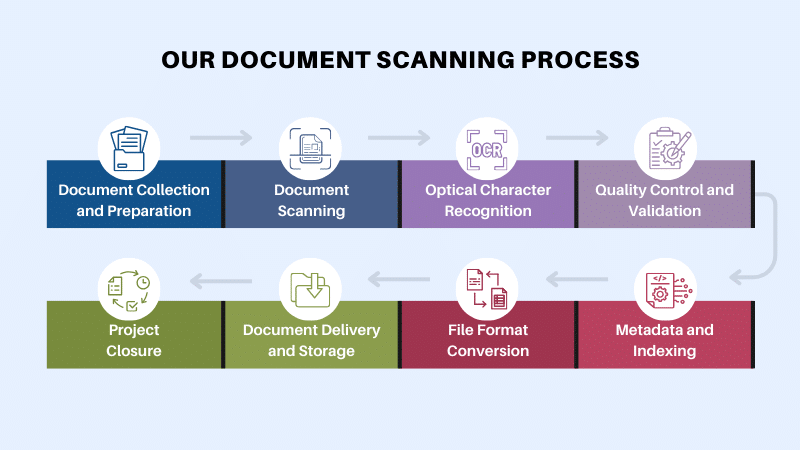
Steps Involved in the Process
The process of document scanning and indexing typically includes:
- Collecting and preparing physical documents
- Scanning files into digital formats
- Assigning index fields or keywords
- Organising files into a structured system
- Performing quality checks for accuracy
- Delivering files in a searchable format
Each step ensures that documents are not only digitised but also easy to locate and use.
Common Challenges and Practical Solutions
Some businesses face challenges when implementing scanning and indexing, such as handling large volumes of documents or deciding on the right indexing system. These issues can be managed by starting with priority documents and expanding gradually.
Working with experienced professionals can also help design a system that fits your needs. A clear plan and step-by-step approach make the process more manageable and effective.
Conclusion
Document scanning and indexing provide a practical way to improve how businesses manage information. By converting paper files into organised digital records, companies can save time, reduce clutter, and improve accessibility.
A well-structured system supports better decision-making and smoother daily operations. With the right support from Access Scanning, businesses can implement reliable document management solutions that make information easier to access, store, and manage in a fast and efficient way.