
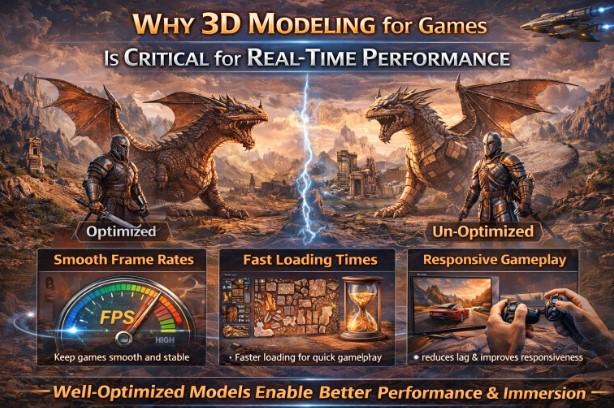
Real-time performance is one of the most important aspects that determines whether a game will feel smooth, responsive, and enjoyable. While players may marvel at visual quality, they quickly abandon games that stutter, lag, or struggle to maintain stable frame rates. Outside of engines, hardware, and code, perhaps one of the most influential yet overlooked contributors to performance is 3D modeling for games.
Understanding Real-Time Performance within Games
Unlike pre-rendered visuals for film or cinematics, games have to render scenes on the fly in response to player input. Every frame must be calculated, drawn, and displayed in a fraction of a second, creating strict performance budgets for geometry, textures, lighting, and animation.
Real-time performance depends on:
- Smooth frame rates
- Low input latency
- Stable memory usage
Whenever assets surpass these limits, performance issues are inevitable-and no amount of powerful hardware can avoid that.
Polygon Count & Geometry Efficiency
Probably the most direct way that modeling can affect performance is through poly count: each and every poly adds to the work the GPU has to do every frame. Too-dense models take up rendering cost with little benefit to visual quality.
Efficient modeling focuses on:
- Using polygons only where they affect the silhouette or deformation
- Avoid unnecessary geometry in flat or unseen areas
- Maintaining Balanced Polygon Distribution
Smart geometry design ensures that assets are detailed while remaining light enough for real-time use.
Clean Topology and Rendering Stability
Topology concerns how the polygons are laid out over a model. Clean topology improves not only animation but also rendering efficiency.
Poor topology can cause:
- Shading artefacts
- Inefficient vertex processing
- Increased draw calls
Models having clean edge flow and logical structure will be easier for the engine to process and less likely to generate performance spikes at runtime.
Level of Detail & Distance-based Optimization
Real-time games typically display dozens, if not hundreds, of assets at any given time. Attempting to render them all at full detail would promptly overload any performance budget.
This is where the level-of-detail systems become essential: assets are modeled in several versions with reduced complexity, enabling the engine to display simpler versions when viewed from afar.
- Effective LOD workflows
- Reduce GPU load for big scenes
- Keep visual quality close to the camera
- Improving performance consistency
LOD systems become inefficient or ineffective without proper modeling preparation.
Modeling for Animation Efficiency
Of all the elements in a game, animated characters and objects are some of the most performance-intensive. Poor decisions about how to model them can greatly increase the workload for both the CPU and GPU when it comes to the playback of animations.
Efficient animation-ready modeling ensures:
- Smooth deformation without excessive vertices
- Reduced skinning calculations
- Stable performance during combat or movement-heavy scenes
Clean geometry provides clean animations without any frame drops when the game gets intense.
Collision and Physics Considerations
This is because models applied for rendering are usually set apart from the collision meshes used in physics. During modeling, failure to separate them may cause performance issues.
Optimized modeling workflows include:
- Simplified Collision Meshes
- Clear separation of visuals from physics geometry
- Setting up pivots and scales efficiently
This reduces unnecessary physics calculations while keeping the accuracy of the interactions.
Memory Usage & Asset Streaming
Real-time performance is not only about rendering speed but also memory management. Large models and inefficient geometry increase memory usage, leading to longer loading times and possible crashes.
Well-modelled assets support:
- Faster asset streaming
- Reduced memory footprint
- Stable performance during scene transitions
Cross-Platform Performance Challenges
The modern games are targeting everything from high-end PC and consoles to mobile platforms; modeling decisions have to take that into consideration without creating separate asset pipelines for each.
Efficient modelling allows:
- Scalable Asset Quality
- Smooth gaming on every device
- Reduced platform-specific rework
3D modeling is central in game production to ensure assets can adapt smoothly to a wide range of hardware capabilities.
Smart Modeling to Reduce Draw Calls
Draw calls are generated when the engine orders the GPU to render objects. Too many draw calls can seriously degrade the performance, sometimes even more than single heavy assets.
Some modelling techniques to reduce draw calls include:
- Batching assets
- Modular design using shared materials
- Avoiding unnecessary object separation
These practices allow the engine to process scenes more efficiently.
The Cost of Fixing Performance Late
One of the biggest risks in game development is ignoring modeling efficiency until late production stages. Poor modeling usually brings performance issues that need significant rework to fix.
Late-stage fixes may include:
- Rebuilding assets
- Re-work Animations
- Level redesigns
Planning performance-aware modeling from the outset reduces time, budget, and development effort.
The Role of Professional Pipelines
As game scope continues to grow, studios seek outside expertise to maintain a performance standard. Working with experienced 3D modeling services helps ensure that assets are built to meet real-time requirements from the outset.
Professional pipelines emphasize:
- Performance budgets per asset
- Clean topology and optimization standards
- Engine-specific best practices
- This reduces risk and enhances production stability
Player Experience and Perceived Quality
Players may not understand technical details, but they immediately feel the consequences of bad performance. Lag, stutter, delayed input-things like that-break immersion way more than visual imperfections. It helps in:
- Strong performance
- Improving player retention
- Improving reviews and ratings.
- Building trust in the quality of the game
Conclusion
Real-time performance is not something added at the end; rather, it’s part of a game right from the concept. From geometry efficiency and topology to animation readiness and scalability, 3D modeling for games makes critical differences in how well the game will perform. A studio that can practice performance-aware modeling methods will be able to make graphically impressive games that stay fluid, stable, and enjoyable across a wide array of platforms.